INDUSTRIAL TRADE ESTIMATING
Industrial Piping Estimating Services
Send the piping drawings, specifications and bid scope for a project-specific proposal. Define whether you need a material takeoff, fabrication quantities, installation pricing or a combined piping estimate before work starts.
For process piping contractors, mechanical subcontractors and industrial bid teams.
YOUR DRAWINGS. A DEFINED PROPOSAL.
Get your process piping quote.
Send your details right here. Share the package you’re bidding and the output you need.
- One trade or a combined industrial package
- Quantities only or a priced cost breakdown
- Scope, fee and delivery agreed before work
DEFINE THE BID PACKAGE
What goes into the process piping estimate?
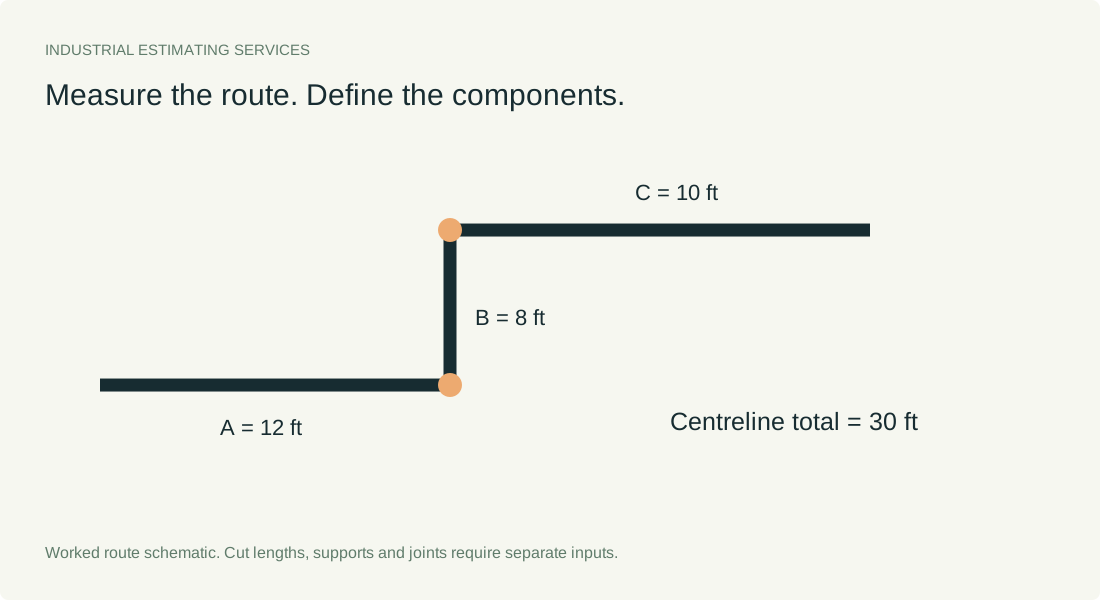
A line on a P&ID identifies process intent; it does not by itself establish the installed route length. A detailed quantity takeoff needs sufficient dimensional information from isometrics, layouts or an agreed model. Missing dimensions should become a clarification or an explicit allowance, rather than an unexplained measured quantity.
| Scope | Quantity detail | Unit basis | Review point |
|---|---|---|---|
| Pipe | Length by nominal size, material, schedule and line specification | LF or m | Keep different materials and specifications separate. |
| Fittings and valves | Count by type, size, rating and connection | EA | Reconcile vendor assemblies before adding loose components. |
| Connections | Shop and field joints by connection type | EA | State the counting convention; do not equate every fitting to one weld. |
| Supports | Standard and detailed supports within the agreed package | EA / weight | Clarify whether engineered supports are measured, quoted or excluded. |
| Testing and finishing | Specified testing, preparation, coating and insulation | Defined unit / allowance | Requirements follow project specifications and the execution plan. |
Documents to include with your enquiry
Send the latest available revisions and identify any documents still to follow. The proposal can then distinguish fully defined work from items requiring clarification.
- P&IDs and line list with current revisions
- Piping isometrics or dimensioned layouts
- Piping specifications, valve schedules and support details
- Insulation, coating and testing requirements
- Shop/field split, battery limits, project location and bid date
Scope boundaries to resolve before pricing
- Vendor skid internal piping versus contractor connections
- Field closures and tie-in work omitted from fabrication drawings
- Flange accessories and specialty items inside vendor packages
- Scaffolding, access equipment and temporary test arrangements
- Demolition, disposal and reinstatement in an existing plant
Include the bid instructions and relevant vendor quotations so responsibilities can be reconciled against the drawings. Exclusions should be explicit and consistent across the takeoff, cost sheets and proposal.
Shop fabrication and field erection
Keep fabrication quantities separate from installation scope so a spool package is not priced twice. Identify loose material, shop joints, field joints and site connections using the agreed drawing conventions. Record handling and delivery boundaries alongside the quantity sheets.
A defensible labor basis
Separate the measured quantity from the labor basis applied to it. Material, size, wall thickness, connection method, access and work conditions may change the installation effort. A standard productivity adjustment is not a substitute for the actual project execution assumptions.
Testing is a defined scope
Identify the specified examination and pressure-testing scope, responsibility, package boundaries and subcontract allowances. An estimating service quantifies and prices the agreed requirements; it does not replace the engineering design or approve a testing procedure.
A line-level material breakdown
Group quantities by line identifier, nominal pipe size, material specification, schedule and pressure class where defined. Keep pipe length, fittings, valves and connection accessories in separate rows. A stainless line should not inherit the material or labor basis of an adjacent carbon-steel line simply because the routes share a pipe rack. Include drawing references so a reviewer can trace quantities to their input revision.
Joint counts need an explicit convention
Count butt-weld, socket-weld, threaded and flanged connections under the agreed measurement rules. A tee, elbow or valve does not have a universal single-joint allowance. Connections at vendor packages, terminal points and field closures need particular attention. Separate shop work from field work before applying fabrication or erection labor; a combined joint total can conceal an important cost difference.
Examination, testing and completion items
List the specified examination scope, test-package responsibilities, temporary blinds, flushing, cleaning, restoration and records as defined by the contract. Do not assume one radiographic examination percentage applies to every line or service. The applicable code edition and project specifications belong to the engineering basis; the estimating task identifies and prices the requirements supplied.
What changes the estimating fee
The assignment effort depends on the number and clarity of isometrics, line/specification variety, joint detail, shop/field split, pricing requirements and the number of revisions. A quantity-only package and a priced installation estimate should have separate scopes, rather than an unexplained single price based only on floor area.
Cost and effort drivers to define
- Line and specification variety
- Shop versus field installation split
- Access and work-window assumptions
- Testing, finishing and support boundaries
Specify your output package
- Line-level material quantities and drawing references
- Defined joint and support quantities
- Separated material, labor and equipment costs where commissioned
- Written clarifications, exclusions and revision basis
Agree the deliverables before work starts
Specify a quantity-only takeoff or a priced estimate, the required grouping and file format, and whether a drawing register, marked plans and a written basis of estimate are included. Revisions and additions should have a defined scope so both teams understand what changes are covered.
Questions about process piping estimating
Can you estimate from P&IDs only?
A preliminary scope or budget may be possible, depending on available information. Detailed route lengths, fabrication quantities and installation scope require additional documents or clearly recorded assumptions. Scope and estimate purpose must be agreed first.
Can I request quantities without pricing?
Yes, the proposal can separate a quantity-only takeoff from a priced estimate. Specify whether shop and field quantities, material ordering quantities or installed quantities are required.
Will the estimate include every weld and test?
The proposed scope should state the joint-counting method and the testing requirements available in the supplied documents. Unspecified examination percentages or test requirements should not be invented.
Related industrial estimating packages
YOUR NEXT BID
Define your process piping bid package.
Share your drawings, project location, required trades and deadline. Agree the scope, fee and delivery date before estimating begins.